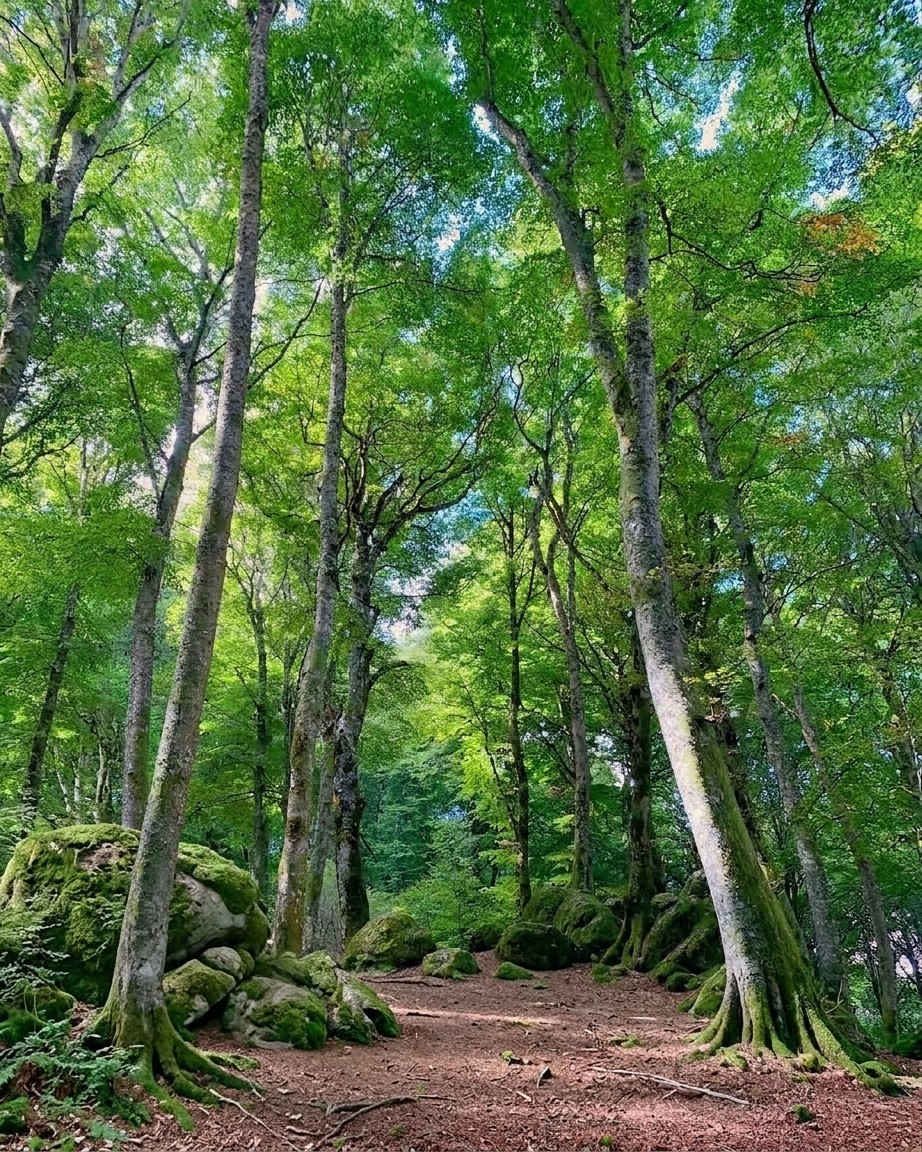
Mount Cimino , at 1,053 meters , is the highest peak of the Cimini Mountains and of the entire province of Viterbo : an ancient volcano , active between approximately 1.35 million and 800,000 years ago , today covered by one of the most impressive beech forests in central Italy. The Roman historian Livy described it as an almost impenetrable forest—an image that still conveys an idea of the density of this forest today.
What makes the Cimino beech forest exceptional is not only its beauty, but its age: many trees are over 200 years old , which is why it is called an " old-growth forest "—a forest that has grown continuously for centuries, uninterrupted by the intensive logging that has altered much of Europe's forests. On July 7, 2017, UNESCO recognized this exceptional value, including the beech forest in the transnational serial site " Ancient Primeval Beech Forests of the Carpathians and Other Regions of Europe ," which brings together old-growth forests from twelve European countries as a testimony to the continent's natural history after the last glaciation.
The area, identified as a Special Area of Conservation and a Special Protection Area in the European Natura 2000 network, extends over 1,000 hectares in the municipalities of Soriano nel Cimino , Vitorchiano , and Viterbo , but the heart of the ancient beech forest protected by UNESCO occupies approximately 50 hectares at the summit of the mountain. Management of the site is entrusted by the Lazio Region to the Monti Cimini – Riserva Naturale Lago di Vico Authority.
A volcano, a sacred forest, a world heritage site
How to recognize the age of a forest, and why the Cimino forest is special
A mountain born from fire
Before it was a forest, Mount Cimino was a volcano. Part of the larger volcanic district of Tuscia, its activity dates back between approximately 1.35 million and 800,000 years ago: a remote era even on a geological scale, which left behind fertile soil, rich in minerals, and a landscape of boulders of trachyte—a magmatic rock—still visible today among the roots of the oldest trees. It is on this volcanic soil, and precisely thanks to it, that an exceptionally vigorous beech forest has developed over the centuries.
The Impenetrable Forest of Titus Livius
That the Cimino Forest has captured the imagination since ancient times is attested by the Roman historian Titus Livius, who in his work described it as an almost impenetrable and terrifying forest. This assessment, read today, is surprising: the Romans, accustomed to building straight roads like the Appian Way and taming any terrain with engineering, regarded this dense, dark forest with an almost religious awe. This is not an isolated case: in many ancient cultures, large broadleaf forests were considered sacred places, populated by sylvan deities, which man entered with respect and caution.
What makes a forest "old-growth"?
The term "old-growth forest," which appears in the official name of the UNESCO site, isn't just a poetic way of saying "ancient forest": it's a precise scientific category. An old-growth forest is an ecosystem that has developed for centuries without significant interruptions due to human intervention—without intensive felling, without replacement of native species, without the forest management practices that, starting in the Middle Ages and especially in modern times, have transformed most European forests into artificial environments, albeit green.
At Cimino, some beech trees are over 200 years old: trees that have survived the unification of Italy, two world wars, and the transformation of the entire region, remaining virtually undisturbed on the mountaintop. It is this continuity, more than just its scenic beauty, that has made the beech forest worthy of the highest recognition UNESCO can bestow on a natural environment.
A recognition that unites twelve countries
On July 7, 2017, the UNESCO World Heritage Committee inscribed the ancient beech forests of Monte Cimino and Monte Raschio, along with other Italian sites, in a transnational serial site that brings together primeval forests from twelve European countries, from the Romanian Carpathians to the German forests, to the beech forests of Lazio. Not a single site, therefore, but a network of testimonies that together tell the same story: that of the beech's progressive recolonization of Europe, which occurred after the retreat of the glaciers at the end of the last Ice Age, approximately 10,000–12,000 years ago.
The Cimino beech forest represents, in this continental mosaic, one of the southernmost and highest points where this natural process has been preserved almost intact to the present day—a fundamental piece to understanding how European forests formed after the Ice Age.
Sources used for this study
- UNESCO World Heritage Center — whc.unesco.org, serial site "Ancient and Primeval Beech Forests of the Carpathians and Other Regions of Europe"
- Cimini Mountains Authority — Lake Vico Nature Reserve
- Municipality of Soriano nel Cimino — "Ancient Beech Forests" section
- Wikipedia (IT) — entry "Monte Cimino" (source checked and integrated with the primary sources listed above)
What to see
| The centuries-old beech trees — some specimens are over 200 years old: imposing trunks that, according to many visitors, resemble the columns of an ancient temple. |
| The Sassi del Cimino — large boulders of trachyte, a volcanic rock, that emerge from the tree roots: evidence of the activity of the Cimino volcano. |
| The CAI trails — three hiking itineraries, managed by the Viterbo CAI section, allow you to reach both the beech forest and the summit of Mount Cimino on foot. |
| Autumn foliage — between October and November the forest lights up with yellow and amber: one of the most evocative times to visit. |
How to get there
- By car (recommended): From Rome, take the A1 towards Florence to Orte, then take the SS204 Ortana or Cassia Cimina towards Soriano nel Cimino. From the village, take the signposted panoramic road to the beech forest parking lot.
- Train + bus: From Rome Termini or Ostiense, take the regional train to Viterbo, then a local bus or taxi to Soriano nel Cimino. From there, you'll need your own transportation or a guided tour to reach the beech forest.
- On foot: from the village of Soriano nel Cimino, the CAI trails lead up to the beech forest and the mountain summit.