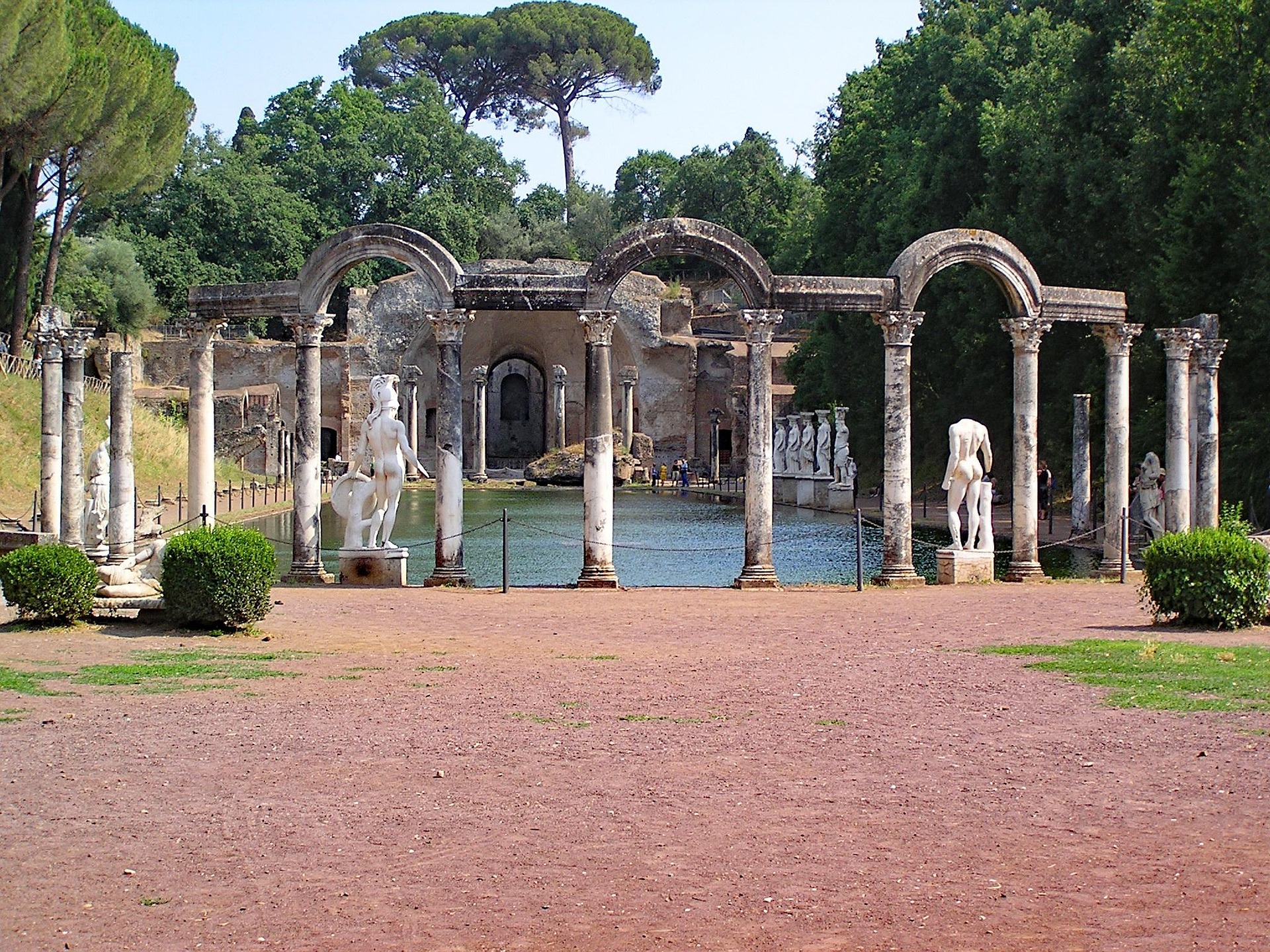
Built between 118 and 138 AD by order of Emperor Hadrian , at the foot of the Tiburtine Mountains , Hadrian's Villa is not a simple country residence: it is an ideal city . On a 120-hectare plateau, between two tributaries of the Aniene River, the emperor built over thirty buildings that reproduce the most famous monuments seen during his travels in the provinces of the Empire: the Poikile in Athens , the Canopus in Alexandria in Egypt , the Maritime Theatre as a private refuge on the water.
Hadrian was a man of encyclopedic culture: philosopher , architect , musician , and tireless traveler . He wanted to gather in Tivoli the places and architecture that had most impressed him during his travels. The result is a complex unprecedented in Roman history, combining an imperial residence, a museum of foreign architecture, and a place of study and meditation.
UNESCO recognition, which came in 1999 , defined Hadrian's Villa as a masterpiece that brings together the highest forms of expression of ancient Mediterranean cultures. Its monuments played a fundamental role in the rediscovery of classical architecture by great Renaissance and Baroque architects, from Pirro Ligorio to Piranesi . The works of art that once decorated the Villa are now preserved in some of Europe's most important museums.
Source: Ministry of Culture — cultura.gov.it/luogo/villa-adriana-e-villa-d-este; Institute of Hadrian's Villa and Villa d'Este — villae.cultura.gov.it; UNESCO World Heritage Centre — whc.unesco.org
The Age of Hadrian
The Golden Age of the Roman Empire and the world that inspired the Villa
A century called "happy"
Hadrian's Villa was built at a crucial moment in Roman history: the 2nd century AD, remembered by ancient historians as the "beatissimum saeculum," the Empire's happiest century. It was the period of the so-called adoptive emperors—from Nerva to Marcus Aurelius, between 96 and 180 AD—when power no longer passed through blood lineage, but through the choice of the reigning sovereign, who adopted as his son and heir the man deemed most capable of governing. This system brought Rome a long period of internal peace, economic stability, and widespread prosperity throughout the provinces, after the most turbulent decades of the Flavian dynasty.
Hadrian ruled right at the heart of this period, from 117 to 138 AD. Unlike his predecessor and cousin Trajan, who had brought the Empire to its greatest extent with his conquests in Dacia and Mesopotamia, Hadrian chose an opposite strategy: consolidation rather than expansion. He gave up some difficult-to-defend eastern territories and invested the state's energies in building stable and defensible borders. The most famous is Hadrian's Wall, the great 117-kilometer-long fortification built in Britain between 122 and 127 AD to mark and protect the northern edge of the Empire.
A traveling emperor
What makes Hadrian unique in Roman history is his method of governing: by traveling. He spent much of his reign away from Rome, personally visiting nearly every province of the Empire—from Britain to Syria, from Africa to Egypt, from Spain, where he was born in Italica near present-day Seville, to his beloved Greece. These were not pleasure trips: the emperor personally supervised local administration, financed public works, restored temples and cities, and met with the people of the provinces. The goal was to make the Empire a more cohesive whole, in which the differences between Rome and the conquered territories became increasingly blurred: a phenomenon historians call Romanization, and which perhaps reached its peak in the second century.
His love for Greek civilization earned him first the derogatory nickname "Graeculus"—the little Greek—and then the much more enduring nickname of Philhellene: friend of the Greeks. He was the first Roman emperor to grow a beard in the manner of the Hellenic philosophers, a fashion his successors would follow for nearly two centuries. In Athens, one of his favorite cities, he financed libraries and aqueducts, completed the Temple of Olympian Zeus, which had remained unfinished for centuries, and founded the Panhellene, a religious and cultural league of Greek cities designed to revive the prestige of Hellenic civilization within the Empire.
Daily life and society in the 2nd century
The Roman society under Hadrian was wealthy, highly urbanized, and multicultural. The cities of the Empire—from Rome to Ephesus, from Leptis Magna to Londinium—shared a common urban infrastructure of public baths, theaters, libraries, aqueducts, and forums: travelers from one province to another found a recognizably Roman lifestyle everywhere, albeit mixed with local customs and traditions.
The baths were the heart of daily social life: places not only for hygiene, but also for meeting, business, and leisure, frequented by people of all social classes. Hadrian himself intervened several times in the economic life of the cities he visited: in Athens, for example, he imposed precise rules on olive oil producers to guarantee availability and control prices, and he favored fishermen by allowing them to sell their catch directly to citizens, without intermediaries.
Culture was a huge social value. In the second century, being an intellectual—a professor of rhetoric or philosophy—could mean a comfortable life, with steady salaries, fees for public lectures, and gifts from wealthy students. Aristocratic women, such as Empress Sabina, wife of Hadrian, enjoyed significant public prestige—evidenced by statues and inscriptions dedicated to them in the cities of the Empire—though they remained excluded from political office.
On a religious level, the 2nd century was a time of great openness: the ancient Roman cults were increasingly joined by deities and rites from the East and Egypt, along with Greek mystery cults, such as the Eleusinian ones, into which Hadrian himself wanted to be initiated, the first Roman emperor to do so.
The meaning of Hadrian's Villa: otium at the service of power
Hadrian's Villa is part of an ancient and deeply rooted tradition in Roman society: that of the otium villa, the country residence where the elite retreated to read, write, and discuss philosophy, far from the negotium, the business and public obligations of city life. The Tivoli area, with its hilly landscape and water sources, was already a favored location for this type of residence in the Republican era.
But Hadrian's Villa was never simply a resting place. In the final years of his life, growing impatient with the imperial palace on the Palatine and the chaos of city life, Hadrian moved the very seat of the Empire's government there. The Villa thus became a true open-air government palace, capable of housing the court, the administration, diplomatic guests, and the emperor's private and cultural life: a unique synthesis of power and leisure, which even today makes the site a unique example in the history of Roman architecture.
Sources used for this study
- Treccani — Italian Encyclopedia, entry on "Hadrian (emperor)" — treccani.it/enciclopedia/adriano-imperatore
- Treccani — "An Aesthete Emperor: The Cult of Beauty in the Classicism of the Age of Hadrian," History of European Civilization edited by Umberto Eco — treccani.it
- Wikipedia (IT) — entry "Trajan and Hadrianic Age" and entry "Hadrian" — it.wikipedia.org
- Wikipedia (IT) — entry "Condition of Roman women in the 1st-2nd century AD", from J. Carcopino, Daily life in Rome at the height of the Empire
- Italian National Commission for UNESCO — "Hadrian's Villa (Tivoli)" factsheet — unesco.it
- Il Sole 24 Ore — "Hadrian, Emperor and Pop Icon" — ilsole24ore.com
What to see
| The Pecile— the large portico with a central pool, 232 meters long. Hadrian strolled here every morning. One of the most evocative views of the site. |
| The Canopus— a 119-meter-long water basin, adorned with columns and replicas of Greek statues. The most photographed spot at Hadrian's Villa. |
| The Maritime Theatre— an artificial island connected to the mainland by drawbridges. The emperor's most private retreat, where he retreated to study. |
| The Grandi and Piccole Terme— two thermal bath complexes with decorated domes and exedras. The Piccole Terme are also accessible to those with mobility difficulties. |
| The Museum — at the beginning of the route. It houses the reconstruction model by the architect Italo Gismondi (1956) and the finds discovered during excavations over the last seventy years. |
How to get there
- Cotral (recommended): Metro B to Ponte Mammolo, then take the Cotral bus via Prenestina, stopping 300 meters from the entrance. Frequent services.
- Train + Bus: From Termini or Tiburtina, take the FS train to Tivoli station, then take the CAT 4 or CAT 4X local bus, stopping in front of the entrance.
- By car: A24 Rome–L'Aquila, Tivoli exit, then Maremmana Inferiore for 2.5 km following signs for Hadrian's Villa. Paid parking at the entrance.