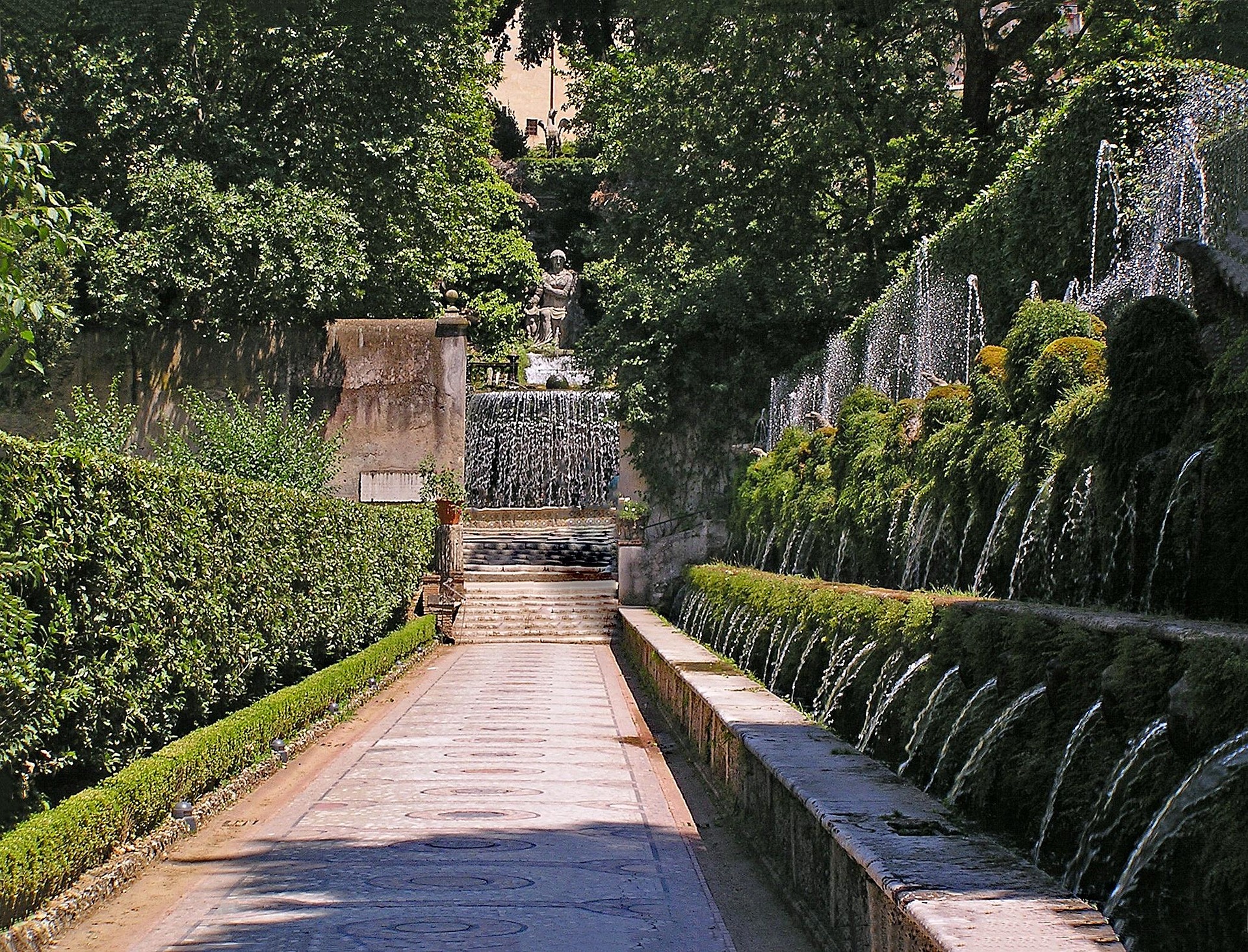
Villa d'Este was built starting in 1550 at the behest of Cardinal Ippolito II d'Este , appointed governor of Tivoli by Pope Julius III . The project was entrusted to the Neapolitan architect Pirro Ligorio, who transformed a former Benedictine convent into one of the most sumptuous residences of the Italian Renaissance .
The true protagonist of the Villa is the garden: over 500 fountains , nymphaeums , and water features distributed across terraces sloping down towards the Tiburtina plain, powered entirely by natural water pressure, without any mechanical pumps. This 16th-century hydraulic engineering system still functions today exactly as Ligorio designed it, thanks to water drawn from the Aniene River.
From the upper terrace, with the villa's frescoed rooms, the route descends through the Avenue of One Hundred Fountains , the Fontana dell'Ovato , and the Rometta —a scenic miniature of ancient Rome—to the majestic Fountain of Neptune. UNESCO recognition, awarded in 2001, recognized the garden's universal value as a masterpiece of European landscape design, a model that would influence garden design in the centuries to come, from Versailles to the English gardens of the 18th century.
Source: Ministry of Culture — cultura.gov.it/luogo/villa-adriana-e-villa-d-este-villa-d-este; Institute of Hadrian's Villa and Villa d'Este — villae.cultura.gov.it; UNESCO World Heritage Centre — whc.unesco.org
The World of Hippolytus II of Este
Renaissance, cardinal courts and the birth of the garden of wonders
The Italian 16th Century: Splendor and Crisis
Villa d'Este was founded in the mid-16th century, during the years of the Italian Renaissance, both its most mature and its most turbulent period. It was the century of the great courts—the Medici in Florence, the Este in Ferrara, the Gonzaga in Mantua, and the papal Rome—where artistic patronage reached unprecedented levels. But it was also the century of the Italian Wars, which between 1494 and 1559 saw the great European powers—France, Spain, and the Habsburg Empire—vying for control of the peninsula. It was also the century of the Protestant Reformation and the subsequent Catholic Counter-Reformation, initiated by the Council of Trent between 1545 and 1563.
In Rome, in particular, the 16th century was the century of patron popes and cardinal courts. Each cardinal, like a petty sovereign, maintained his own court of secretaries, artists, scholars, and servants, with palaces in the city and villas for recreation outside the walls. The pomp of these courts required enormous resources, often guaranteed by a dense network of ecclesiastical benefices—abbeys, bishoprics, dioceses—which a cardinal could accumulate in several countries simultaneously.
Ippolito II d'Este: a prince of the Church
Born in Ferrara in 1509, Ippolito II d'Este was the son of Duke Alfonso I d'Este and Lucrezia Borgia, and therefore the nephew of Pope Alexander VI. He was initiated into an ecclesiastical career from an early age: Archbishop of Milan at just ten years old, and made a cardinal before he turned thirty by order of King Francis I of France. He remained a faithful political ally throughout his life within the College of Cardinals, serving for a long time as Cardinal Protector of French interests before the Holy See.
His was the career of a true statesman: papal legate in France during the difficult years of the religious wars between Catholics and Huguenots, governor of Tivoli from 1550 onwards, he came close to being elected to the papal throne several times but never achieved it. He was also one of the great patrons of the arts of his time: he supported the composer Giovanni Pierluigi da Palestrina, the sculptor and goldsmith Benvenuto Cellini, and the poet Torquato Tasso, helping to make his court one of the liveliest cultural centers of sixteenth-century Rome.
The model of Hadrian's Villa
When Ippolito II gained control of Tivoli in 1550, he decided to build a residence worthy of his rank, adapting an ancient Benedictine convent annexed to the church of Santa Maria Maggiore. The project was entrusted to the Neapolitan architect, painter, and archaeologist Pirro Ligorio, already an expert in Roman excavations and antiquities.
The model the two men looked to was Hadrian's Villa, just a few kilometers away: the same idea of a world-class residence, capable of combining luxury, classical culture, and the ostentation of power through architecture, according to an ideal of princely leisure that directly echoed that of the Roman emperor. Historical sources relate that Hippolytus II had marble, statues, and ancient materials removed from the ruins of Emperor Hadrian's villa, now abandoned for centuries, to decorate his new residence. This is an episode that today is viewed critically by art historians and cultural heritage conservationists, but which was common practice in the 16th century, when antiquity was considered more of a quarry of materials and inspiration than a heritage to be preserved intact.
The garden as a theatre of nature and power
The true masterpiece of Villa d'Este is its garden, one of the finest examples of the so-called "Italian garden": a style born in the Renaissance, based on a geometric and symmetrical design, terraces, orderly hedges, statues, and, above all, elaborate water features. Unlike medieval gardens, which were enclosed and primarily used for practical purposes, such as vegetable gardens and herbaria, the Renaissance garden is conceived as a performance: a symbolic journey that visitors follow through mythological allegories and classical references, capable of simultaneously astonishing and educating.
At Villa d'Este, water takes center stage, thanks to a hydraulic engineering system extraordinary for the time, capable of powering hundreds of fountains using only the natural slope of the land and the waters of the Aniene River, diverted through a long underground conduit dug specifically beneath the city of Tivoli, without any mechanical pumps. The garden was also a place for gatherings, literary conversations, and performances: the Renaissance villeggiatura, a direct descendant of the Roman one, was a crucial moment in the social life of the elite of the time, where diplomacy, culture, and leisure intertwined far from the heat and chaos of Rome.
Sources used for this study
- Treccani — Italian Encyclopedia, entry "Este, Ippolito II d'" — treccani.it/enciclopedia/ippolito-ii-d-este
- Wikipedia (IT/EN) — entry "Italian Renaissance" and "Ippolito II d'Este" — it.wikipedia.org / en.wikipedia.org
- Wikipedia (IT) — entry on "Protestant Reformation" (section on the Roman Curia and the cardinal courts during the Renaissance)
- Italy On This Day — Biography "Ippolito II d'Este – Cardinal" — italyonthisday.com
- Ministry of Culture / Institute of Hadrian's Villa and Villa d'Este — villae.cultura.gov.it (history of the complex and the garden)
What to see
| The Avenue of One Hundred Fountains — a long canal lined with one hundred small, continuously flowing fountains, among the most photographed features of the garden. |
| The Fontana dell'Ovato — one of the most spectacular fountains, with a large semicircular basin and a waterfall. |
| La Rometta — a miniature reconstruction of ancient Rome, with the obelisk, the Tiber Island-boat, and the Capitoline Wolf. |
| The Fountain of Neptune — the highlight of the route: a mighty jet of water rising against the backdrop of the terraces. |
| The Organ Fountain — a real hydraulic organ that still plays today thanks to the power of water alone, activated every two hours starting at 10:30 a.m. |
How to get there
- Train + bus (recommended): From Rome Termini or Tiburtina, take the FS train to Tivoli station, then take a local bus or a 15-20 minute walk uphill to the historic center.
- Cotral: Metro B to Ponte Mammolo, then take the Cotral bus to Tivoli center.
- By car: A24 Rome–L'Aquila, Tivoli exit, follow signs for the historic center. Paid parking is available near Piazza Trento.
- On foot from Hadrian's Villa: a nature trail connects the two villas through the Tivoli olive groves; not suitable for strollers or people with mobility difficulties.